Our systems
HCW underfloor heating systems – Flexible solutions for all your projects
Factory-preassembled panels for concrete slabs or over joists, adapted to all your projects.
Installation types
Choose the installation type that suits you best
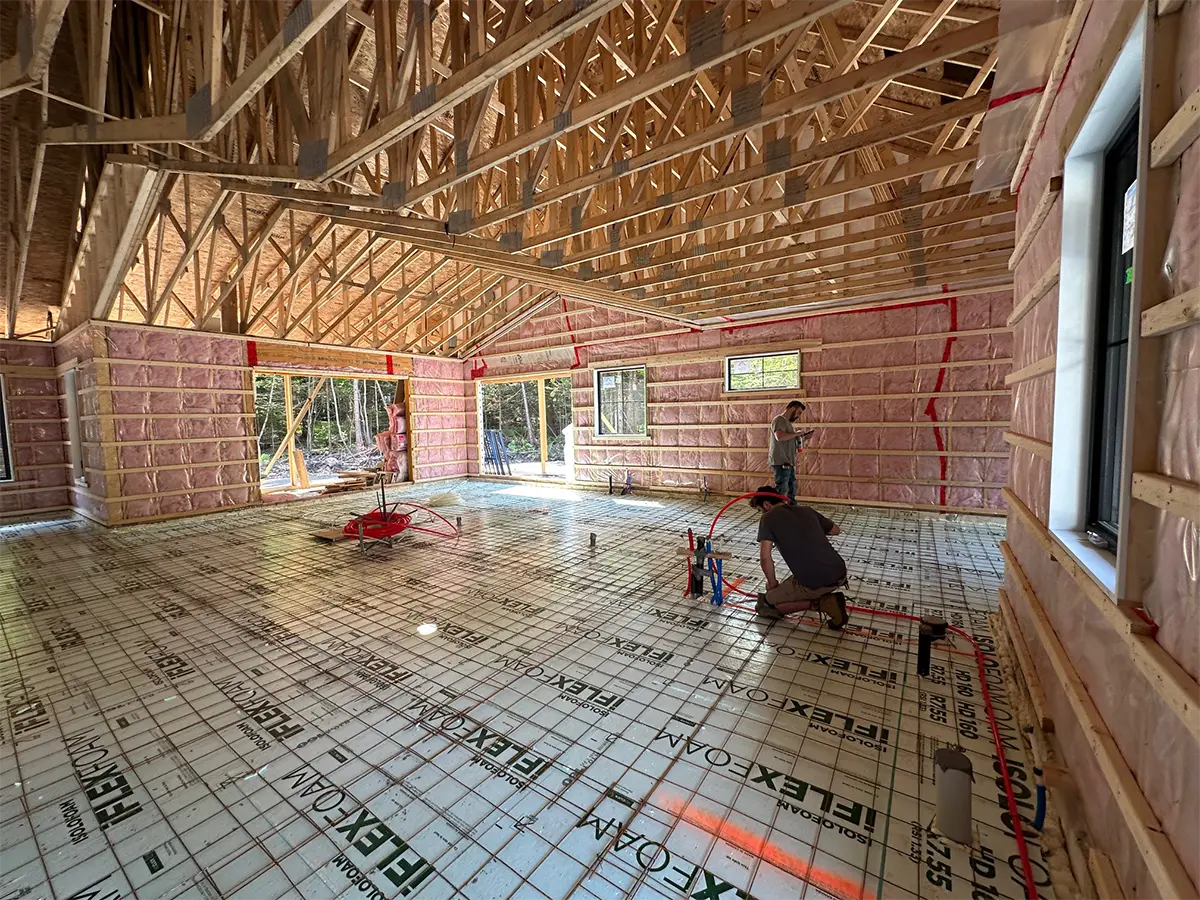
Underfloor heating embedded in concrete slab or installed over joists
This method involves embedding the pipes, always PEX, directly into a concrete slab or on an upper floor. The pipes are secured to a wooden subfloor and covered with at least an 1½” concrete pour.
It’s a popular choice for new builds, especially for basements, slab-on-grade ground floors, and garages.
Strong, reliable, and long-lasting, it’s a proven solution for a stable installation!
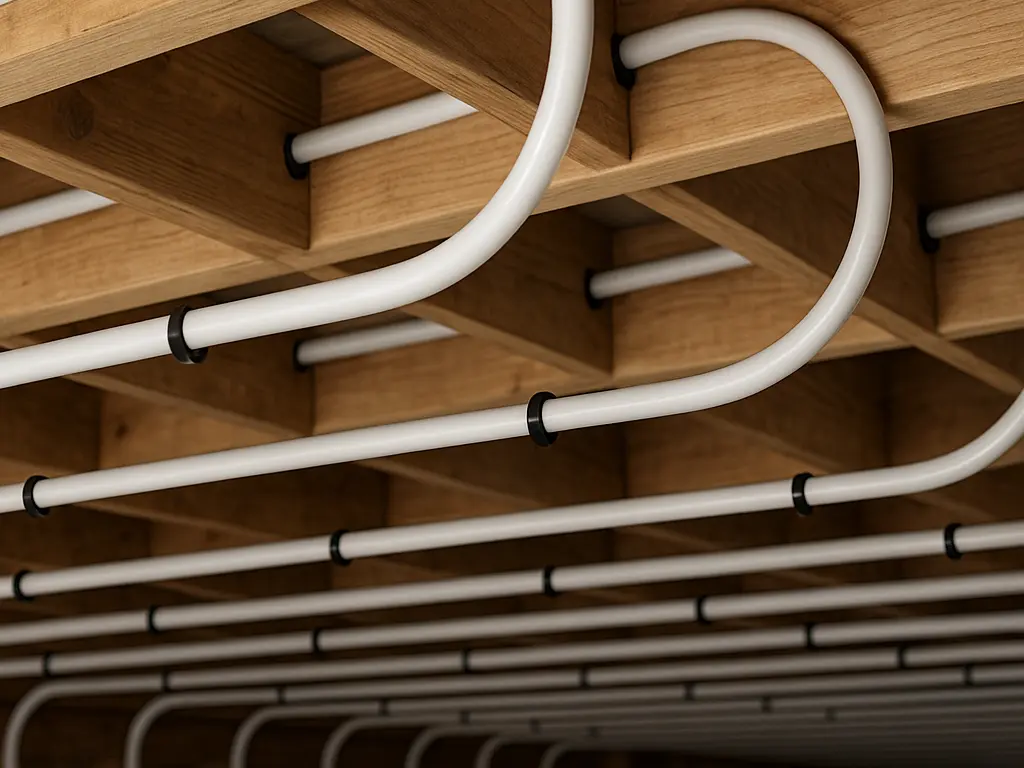
Between-joist installation
The piping is installed beneath the subfloor, between the joists, without altering the existing surface. This method is ideal for upper floors or situations where the added weight of cement is not an option.
Often, in the case of a prefabricated home, the ground floor arrives with interior walls already in place. In such cases, pouring concrete to embed the pipes in the floor isn’t possible. If there’s a basement, the pipes can be embedded in the slab, while for the ground floor, between-joist installation becomes the best option.
However, the water temperature needs to be higher for between-joist systems — around 55°C, compared to 40°C in a slab. The boiler must be set to a higher temperature, and a mixing valve is used to reduce the water temperature before feeding the slab system.
Applications
Discover the many applications of the HCW system

Primary residential heating
Underfloor heating can easily serve as the main heating system in a home. Ideal for larger residences or high-performance homes, it provides stable, even warmth in every room.
Often seen as the ultimate in comfort, it fits perfectly into an energy-efficient approach or a net-zero energy home.

Heating for specific zones
With underfloor heating, each room in your home can be heated to a different temperature. Each space becomes its zone, controlled by an individual thermostat.
To accomplish this, each room is isolated during tubing installation. Beginning at the system’s installation point, a loop (or multiple loops) is laid out through the targeted room before returning to the mechanical room. This procedure is repeated for every zoned area.
If using a single thermostat, installation is simpler — the temperature remains consistent throughout the home. In this case, the tubing is installed without accounting for interior divisions.

Water or glycol-based systems
Hydronic radiant floor systems are water-based, which can be mixed with glycol, typically at a ratio of 30% to 50%, depending on your needs.
Glycol serves a single purpose: to prevent freezing. For all other aspects, water remains the best option, as it transfers heat more efficiently, is less viscous, and doesn’t need to be replaced every 7 to 8 years.
In most residential settings, a 30% glycol mix is usually sufficient. However, for basements where there's no risk of freezing, plain water is ideal.

Outdoor snow and ice melting
Our system can also be used to melt snow and ice on outdoor surfaces such as sidewalks, stairs, and driveways.
Integration
Integrate our system into your home
An underfloor heating system
Powered by various energy sources
Electric or gas boilers, bi-energy systems, geothermal, and even solar power: multiple energy sources can be used to heat the water in a hydronic system.
Electric boilers, natural gas or propane boilers, outdoor wood boilers, geothermal systems, and air-to-water heat pumps are all effective solutions for heating water. The heated water is then distributed throughout the home using our system.
100% compatible with all types of flooring
The possibilities for flooring are endless, allowing you to personalize your space to your taste.
Water- or glycol-based radiant floor heating operates at low temperatures when installed in a concrete slab. This means there’s no risk of overheating, even under an island, inside a closet, or in other confined spaces, making the installation of the tubing much easier.
Easily integrates with other hvac components
Hydronic underfloor heating pairs perfectly with other components of your HVAC system, such as fan coil units.
Using individual thermostats for each zone allows for precise temperature control, ensuring optimal comfort and efficient energy management.
Want to learn more?
Discover the many benefits of our hydronic underfloor heating systems!
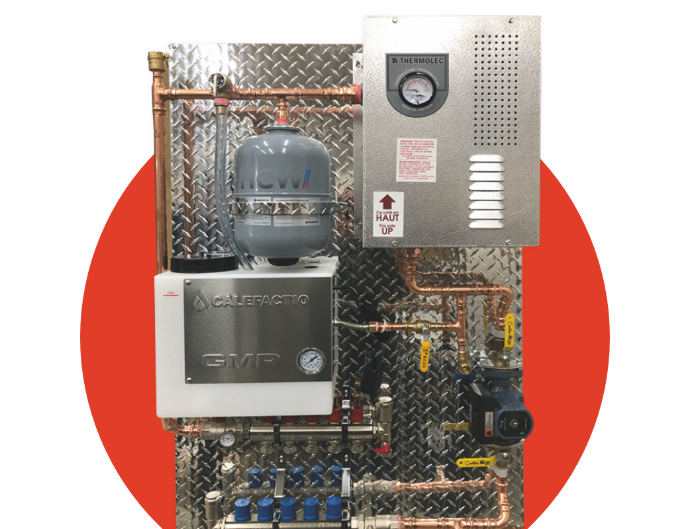
The HCW panel
Our preassembled panel — A turnkey system ready to be installed!

1- Automatic Air Vent
This part, which is always installed at the top of the assembly, makes it possible to remove air from the system without releasing any water.
2- Relief Valve
The relief (purge) valve drains water to relieve excess pressure.
3- Expension Tank
The system needs an expansion tank because the density of water varies depending on its temperature. Our high-quality and glycol-compatible (up to 50%) expansion tanks are suitable for hot water installations, solar heating systems and cooling systems. They are equipped with a bladder (made of EPDM rubber) to separate air from water and avoid contact with the steel. Made from two layers of welded steel, our tanks are designed to withstand high pressure loads and come with an exceptional five-year warranty.
4- Boiler (water heater)
Our high-performance Thermolec TMB electric boilers are both reliable and affordable. Designed with high-quality components, they come with an impressive ten-year warranty on parts. Some of our models even include an electronic control board that supports the use of two energy sources. It should be noted that other brands of boilers may also be compatible with our systems.
5- Copper Press Fittings
Copper press fittings require no soldering. A specialized tool ensures a perfect watertight joint.
6- Injection Valve
The main role of the injection valve is to automatically maintain water pressure (or the pressure of the water/glycol mixture) in the closed loops of the radiant heating system.
7- Pump
Our systems use one of the most popular and versatile pumps on the market. The pump features a cast iron or stainless steel housing, an integrated removable non-return valve, and a three-speed motor. The range of available speeds makes it possible to customize and optimize the pump settings based on the size of the system.
8- Manifold
The manifold directs the water to the different sections of your underfloor heating system. Capable of a high flow rate (up to five litres per minute), our stainless steel manifolds are equipped with a surface thermometer, isolation valves, a bleeder or drain (as required) and a wall bracket. You can add 24-volt zone valves to provide better comfort control in each room of the building.
Why HCW
A system built to last
Simple and Easy
In order to make your life easier, we do most of the work ourselves by pre-assembling the panel for your underfloor heating system. All you need to do is install the provided tubing and you’re done. You’ll receive an easy-to-follow installation guide with your order and serveral how-to videos are available here. If you prefer to have a plumber take care of the installation, we will gladly recommend one of our affiliated experts.
Durable and Reliable
Enjoy long-term savings on heating costs with our revolutionary underfloor heating systems. Virtually maintenance-free, built to last for the life of your building and covered by a rock-solid warranty, HCW’s underfloor heating systems are sure to add value to your building.
Versatile and Made-to-Order
Every HCW panel is custom-assembled in our factory. It is designed based on the characteristics of your building: the energy source, the surface area and the number of rooms to be heated. You’ll enjoy savings thanks to our custom manufacturing system: you only pay for the parts you need. This versatile system works with all types of floor coverings.
Floor coverings
100% compatible with all types of floor coverings
Our water-based underfloor heating systems are compatible with all types of floor coverings: hardwood, floating wood, ceramic and many more. Let your imagination run wild: the possibilities are endless!

Frequently asked questions
Features of hydronic underfloor heating systems
Can I heat my entire home with an underfloor heating system?
Of course! Our water-based underfloor heating systems produce enough heat to keep your entire home at your desired temperature. They’ll meet your heating needs in even the coldest weather, with no need to add other heat sources.
Why choose a hydronic underfloor heating system over an electric one?
Water-based underfloor heating systems are ideally suited to new construction. Unlike with systems that use electric wires, repairs will never involve digging up your floors all the way down to the concrete.
Discover the benefits of hydronic underfloor heating systems
Are your systems water-based or glycol-based?
Our systems use a water-based liquid that contains some antifreeze (glycol). The latter protects the underfloor heating system against breakage by preventing the pipes from freezing.
What is an HCW preassembled panel?
It is a turnkey system, preassembled in the factory and ready to install. The panel includes the automatic air vent, the safety valve, the expansion tank and the boiler. It is delivered in a single box, with no soldering required, and pressure-tested for 3 hours.
Can underfloor heating be installed in a concrete slab and between joists?
Yes. In a slab, the PEX pipes are attached to a wood panel with a concrete pour of at least 1 1/2 in., a popular method for basements, slab-on-grade ground floors and garages. Between joists, the piping is fastened under the subfloor without changing the existing surface, which suits upper floors or situations where added weight must be avoided.
What water temperature is needed in the slab and between joists?
About 40 °C in the slab and about 55 °C between joists. If the house combines both, the boiler is set to the higher temperature and a mixing valve lowers the temperature to supply the slab.
How much glycol should be added to the water?
Glycol is only used to prevent freezing, usually in a proportion of 30 to 50%. In a family home, a 30% mix is generally enough. For a basement, water alone is ideal since there is no risk of freezing.
Is underfloor heating compatible with all floor coverings?
Yes, it is compatible with all types of floor coverings. When installed in a concrete slab, it runs at low temperature, so there is no risk of overheating, even under a kitchen island or in a closet.
Can the system be used to melt snow outdoors?
Yes. The HCW system can also be used to melt snow and ice on outdoor surfaces such as sidewalks, stairs and driveways.
Your project
Ready to start your project?
Get your price online in under 2 minutes, or talk to a specialist at 1 877 687-2419.